
Audit and due diligence tend to surface when outside capital, debt financing, or a serious acquisition discussion enters the picture. In our experience building finance functions for SaaS, tech, AI, and e-commerce companies between $1M and $30M in revenue, this is when financial expectations change significantly.
In a recent conversation on the Founder Files podcast, we spoke with Rawan Sakatan, CPA, Director at Weaver about how audits actually show up inside scaling companies, why investors ask for them, and how audit readiness differs from deal readiness.
Many founders and CEOs assume audit readiness and deal readiness are interchangeable. They’re not. Understanding the distinction protects valuation, reduces transaction friction, and prevents last-minute surprises that slow momentum at critical growth moments.
TL;DR
- Audits can appear when companies raise capital, expand lending relationships, or enter acquisition discussions.
- An audit tests whether historical financial statements comply with GAAP. Due diligence evaluates earnings quality, risk, and valuation.
- A company can pass due diligence and still fail an audit, and the reverse can also happen.
- The most common audit issues in growth-stage companies involve accruals, revenue recognition under ASC 606, equity accounting under ASC 718, and documentation gaps.
- Audit readiness comes from disciplined monthly processes, reconciliations, and GAAP-compliant reporting long before an auditor is engaged.
Audits Appear When a Company Is Scaling
Audits are rarely random. In growth-stage companies, audits are often requested by stakeholders when financial expectations increase.
Common triggers include:
- Institutional venture capital or private equity investment
- Expansion of a bank credit facility with formal reporting covenants
- Preparation for a sale process
- Rapid revenue growth where investors expect GAAP reporting
When capital enters the business, the tolerance for informal processes decreases. Investors and lenders want independent validation that the financial statements are presented fairly under Generally Accepted Accounting Principles (GAAP).
An audit provides that validation by testing whether the financial statements are free from material misstatement and supported by appropriate documentation and accounting policies.
In early stages, founders and CEOs often prioritize product development, hiring, and customer acquisition. Financial processes evolve as needed. That approach works until external stakeholders require formal structure, documentation, and consistency across reporting periods.
An audit does not measure ambition or growth potential. It measures whether historical financial statements comply with GAAP.
What Does an Audit Evaluate?
An audit looks backward. It tests whether past financial statements are fairly presented according to GAAP standards.
Key areas of focus include:
- Revenue recognition under ASC 606
- Stock-based compensation under ASC 718
- Lease accounting under ASC 842
- Software capitalization policies (ASC 350-40 / internal-use software)
- Accrual accounting and expense matching
- Internal controls over financial reporting
If you’d like the full US GAAP compliance checklist we use with growth-stage SaaS companies, contact us at cypherfin.com, and we’ll send it to you.
Revenue recognition under ASC 606 is particularly important in SaaS businesses. If a customer prepays for an annual subscription, that full amount cannot be recognized immediately. Revenue must be recognized as the service is delivered over time, typically monthly. This distinction between billing and revenue is one of the most common areas auditors review because invoicing alone does not determine when revenue is earned under GAAP.
Our video SaaS Revenue Recognition Explained: Bookings, Billing, Metrics explains how bookings, billings, and recognized revenue differ and why confusion between those categories creates reporting risk.
Accrual accounting is another area where early-stage shortcuts surface later. Cash basis accounting reflects what sits in the bank. Accrual accounting reflects when revenue is earned and expenses are incurred, even if cash hasn’t moved yet.
Under GAAP, expenses must also be recognized when they are incurred. This includes items such as bonuses, vacation accruals, or legal liabilities that companies sometimes overlook when transitioning from simpler accounting practices.
This transition from cash to accrual is discussed in our video Cash vs Accrual: When Growing Companies Need GAAP and explained further in our article Cash Basis vs Accrual Accounting: What Founders and CEOs Should Understand Before Closing the Books on 2025.
Equity is another area auditors examine carefully. Option grants must be valued correctly, expensed over vesting periods, and supported by board documentation. Spreadsheets without formal reconciliation often create avoidable audit exposure.
Equity accounting becomes especially sensitive during fundraising or exit events because buyers and investors review option grants, fair value calculations, and vesting schedules in detail.
These issues typically stem from systems such as Excel cap tables or basic QuickBooks setups that worked at $1M in revenue but cannot support institutional capital expectations. Investors and lenders expect processes that are documented, repeatable, and scalable.
What Does Due Diligence Evaluate?
Due diligence is not the same as an audit. While an audit tests whether financial statements comply with GAAP, due diligence is broader and more forward-looking. It evaluates whether earnings are sustainable and risks are fully understood.
Common diligence focus areas include:
- Quality of earnings analysis
- Working capital normalization
- Gross margin durability
- Customer concentration
- Cash conversion efficiency
- Unit economics
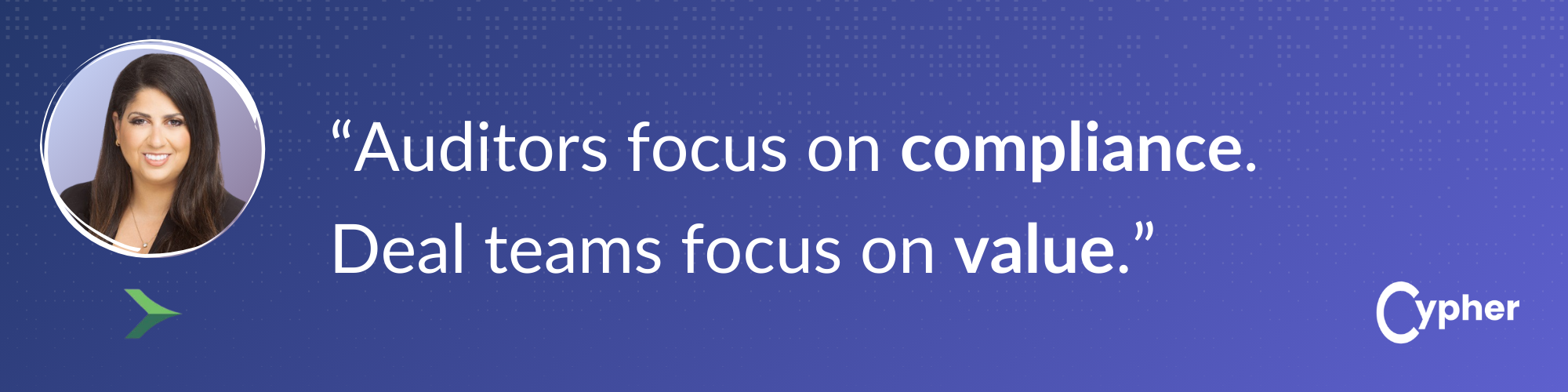
Auditors focus on whether historical transactions comply with accounting standards. Deal teams focus on how those financial results translate into valuation and future performance.
For example, revenue may be recognized correctly under GAAP while accounts receivable grow significantly because billing and collections processes are inconsistent. An audit would validate revenue recognition. Due diligence would examine whether revenue converts to cash efficiently and whether operational assumptions support valuation.
In one SaaS company we supported, tightening invoicing discipline and collections materially improved days sales outstanding and cash conversion. The CFO at Galaxy Digital describes in this testimonial how improving AR processes translated into measurable liquidity improvements.
And in one of our recent podcasts, Profitable But Broke: The 6-Week Runway Crisis, our guest illustrates how strong margins can coexist with liquidity stress if timing and collections aren’t managed rigorously.
This difference explains why a company may receive a clean audit opinion and still face difficult questions during an acquisition or investment process. Working capital swings, churn patterns, or margin assumptions may not affect the audit opinion but can still create uncertainty during diligence and influence valuation.
The Common Mix-Up: Audit vs Deal Readiness
Because audits and diligence often happen around the same stage of growth, founders and CEOs sometime assume that being prepared for one means they are prepared for the other. In reality, the two processes test different things.
A company can be due diligence-ready and still not be audit-ready. In some transactions, investors complete diligence and move forward with an acquisition, only for the company to face its first formal audit later.
We have seen situations where a company successfully exited to private equity but was not prepared for the audit that followed, requiring significant work over the following year to bring financial processes, documentation, and reporting up to audit standards.
The reverse also applies. Clean books are sometimes equated with transaction readiness. Clean books are foundational, but they do not prove that revenue is durable, margins are stable, or cash flow supports growth. Passing an audit does not automatically mean the business will pass diligence without questions about margins, working capital, or earnings quality.
Financial maturity requires both disciplined reporting (audit-readiness) and strategic financial insight (deal-readiness).
Where Growth-Stage Companies Encounter Issues
Scaling companies rarely experience one single failure. Issues accumulate gradually.
Common patterns include:
- Accruals recorded inconsistently across periods
- Revenue timing misaligned with contract terms
- Equity grants tracked without formal reconciliation
- Lack of supporting documentation and reconciliation for key balances
- Manual processes dependent on individual knowledge
At Cypher, we address this by building processes that keep financial records organized and audit-ready. This includes account reconciliations, supporting documentation, registers, and schedules (such as debt and fixed asset schedules), key agreements, cap tables, and a record of month-end journal entries.
A Final Note for Growth-Stage Founders & CEOs
Leadership that integrates structured monthly processes, documented policies, and disciplined forecasting into their operations typically experiences smoother capital raises, cleaner audits, and more efficient transactions.
Our approach combines AI-enabled efficiency with human oversight and CFO-level guidance. It allows companies to scale their finance function without building a full internal department prematurely.
In practice, audit readiness reflects how the finance function operates throughout the year. Companies that maintain reconciled books, documented policies, and organized financial records reduce the cost, stress, and disruption that audits and transactions can create.
Preparing these processes early is far easier than trying to rebuild financial history later.
Frequently Asked Questions
What is the difference between an audit and due diligence?
An audit evaluates whether historical financial statements are presented fairly under GAAP. It is backward-looking and focused on compliance, documentation, and accounting accuracy.
Due diligence is broader. It evaluates sustainability, risk, working capital, quality of earnings, and whether valuation assumptions are defensible. It is forward-looking and transaction-focused.
Both processes review financial information, but they answer very different questions.
Can a company pass an audit and still face problems in due diligence?
Yes. A clean audit opinion confirms GAAP compliance. It does not automatically confirm that margins are sustainable, cash conversion is stable, or working capital is properly structured.
Due diligence teams analyze how financial results translate into future performance and deal value, which often involves deeper contract reviews and operational analysis.
Why does due diligence impact valuation more than an audit?
An audit confirms whether financial statements are fairly presented. Due diligence evaluates whether earnings quality supports the purchase price or investment thesis.
If diligence uncovers issues such as customer concentration, revenue timing inconsistencies, margin volatility, or weak cash conversion, buyers and investors may adjust valuation or deal structure.
At what stage should a growth-stage company prepare for an audit?
Preparation should begin well before an audit is formally required.
Audits are commonly requested when companies raise institutional capital, enter lending agreements with financial reporting requirements, or begin preparing for a sale process.
While there is no fixed revenue threshold, audit expectations commonly arise as companies scale into institutional capital environments or formal lending relationships.
What areas create the most scrutiny for SaaS companies?
For SaaS and subscription-based businesses, the most common focus areas include:
- Revenue recognition under ASC 606
- Deferred revenue treatment
- Stock-based compensation under ASC 718
- Software capitalization policies under ASC 350-40 (internal-use software)
- Accounts receivable and cash conversion discipline
- Customer retention and margin durability
These areas directly affect both audit outcomes and transaction negotiations.
If you’d like the full ASC guidance memo for SaaS companies covering revenue recognition, contract costs, and software capitalization, contact us at cypherfin.com, and we’ll send it to you.