

Why Nexus, Remote Teams, and State Rules Create Hidden Risk for Founders and CEOs
Sales tax is one of those topics leadership teams routinely don’t worry about until it suddenly becomes urgent, stressful, and very expensive.
Across SaaS, AI, and e-commerce companies, the pattern is consistent. Teams are focused on product, hiring, revenue growth, and preparing for capital events. Sales tax feels like a future problem, something to address later.
Until it isn’t.
On a recent episode of Founder Files, I sat down with Monika Miles, President of Miles Consulting Group with more than 25 years of experience, in addition to time at a Big Four firm. We broke down how sales tax actually works today, why modern cloud-based companies are often exposed without realizing it, and how small oversights compound as businesses scale.
If you are a founder, CEO, or part of a leadership team operating across states, managing a remote workforce, or planning a fundraise, this is what you need to know about sales tax.
Sales Tax Has Changed, Nexus Is the Starting Point
Every sales tax conversation starts with one concept: nexus.
Nexus is the minimum level of presence that allows a state to require a company to register, collect, and remit sales tax. Historically, this was relatively straightforward. Companies worried about where they had offices, employees, or inventory.
That changed in 2018 with the Wayfair v. South Dakota Supreme Court decision. Today, there are two types of nexus, and either one can create an obligation.
Physical Nexus: The Risk Hidden in Remote Operations
Physical nexus does not just mean an office.
It can be triggered by:
- Employees working remotely from a state
- Contractors providing implementation or white-glove services
- Inventory stored in warehouses or with third-party logistics providers
- Traveling sales teams making in-state sales calls
Remote work has significantly expanded exposure here. Many SaaS and AI companies create physical nexus simply by hiring talent across states, without realizing the downstream tax implications.
Economic Nexus: How Revenue Creates Obligations
Economic nexus is based on sales activity, not headcount.
Most states set thresholds such as:
- $100,000 in annual sales, or
- 200 transactions, whichever comes first
For subscription businesses, this can escalate quickly. A single customer billed monthly counts as 12 transactions per year. Companies do not need a large customer base to cross these thresholds.
Leadership takeaway: Sales tax can still apply even when your company is fully remote or fully digital.
SaaS and AI Are Often Taxable, Even When Teams Assume They Are Not
One of the most common assumptions discussed was this:
“We are SaaS, so we must be exempt.”
That is often incorrect.
Roughly half of U.S. states tax SaaS in some form. Many companies assume they are safe because California does not tax SaaS, but California is the exception, not the rule.
Several large states do, in fact, tax SaaS, including Texas, Washington, New York, Pennsylvania, and Massachusetts.
Where teams get tripped up is assuming that taxability is determined by what they call their product. In reality, states do not tax based on labels like “SaaS” or “platform.” They tax based on what the customer is actually paying for, as described in contracts and invoices.
When states evaluate SaaS transactions, they look closely at how revenue is categorized. In some states, activities classified as data processing or information services are taxable, even when those services are delivered through software. Access to software may be treated one way, while services performed through that software may be treated another.
Bundled offerings add another layer of complexity. Training, implementation, support, or managed services included alongside software access can change how the entire sale is treated for sales tax purposes. In some cases, a bundle can cause an otherwise non-taxable product to become taxable.
As a result, two companies selling very similar software can face very different sales tax obligations based solely on how their contracts, invoices, and bundles describe what customers are paying for.
Leadership takeaway: Sales tax exposure is driven as much by contract language and billing structure as by the product itself.
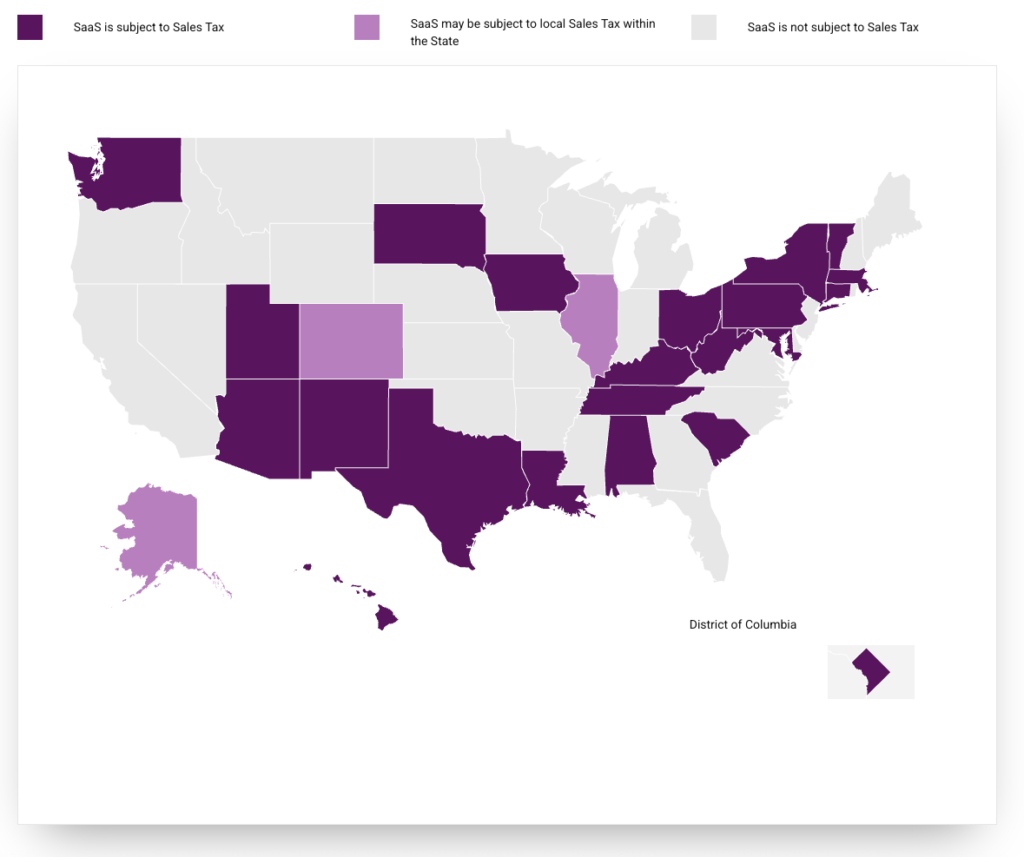
SaaS Taxability Map: A Practical Way to See Where Risk Lives
During the conversation, Monika highlighted how difficult it is for leadership teams to track SaaS taxability across states without a clear reference point.
That is exactly why she and her team at Miles Consulting Group built a state-by-state SaaS Taxability Map, which she shared with us during the episode.
Understanding where SaaS is taxable (and where it is not) can be confusing. Each state applies its own rules to cloud-based software, and those rules can vary based on economic nexus, customer location, and how the software is used.
The map below shows the United States with states color-coded to indicate whether SaaS is taxable, partially taxable, or not taxable under current rules. It is designed to help readers quickly understand geographic sales tax exposure at a glance.
Sales Tax Software Helps, But It Is Not a Strategy
Automation plays an important role in modern finance operations. We use it ourselves.
However, sales tax software alone is not a complete solution.
Companies most often run into problems when:
- Software tracks economic nexus but does not account for physical nexus
- Products are coded incorrectly, resulting in incorrect tax calculations
- System errors or integrations prevent returns from being filed on time
- Teams assume the software can be set up once and left unattended
Sales tax tools can calculate tax accurately when they are configured and monitored correctly. They cannot interpret nuanced state rules, correct historical issues, or represent a company in discussions with tax authorities.
This is where experienced human oversight remains essential.
Leadership takeaway: Automation without ongoing review creates exposure and compounds errors over time.
If Issues Exist, Remediation Can Reduce Exposure
Discovering sales tax issues does not mean panic. It means assessing the scope of the problem and deciding how to address it.
A proper approach begins with a nexus and taxability review, conducted state by state. This step determines where the company should have been registered, whether its products or services were taxable in those states, and how long the issue has existed.
From there, remediation means correcting past sales tax issues in a structured way. In practice, this often involves working with state tax authorities to resolve prior noncompliance, limit how many years they can look back, reduce penalties, and set up the correct process so sales tax is handled properly going forward. In many cases, specialists use Voluntary Disclosure Agreements to achieve these outcomes.
When handled early, remediation can materially reduce total exposure and prevent the issue from escalating during audits, fundraising, or transactions.
Leadership takeaway: Waiting increases both the cost and the number of stakeholders involved.
Collected Sales Tax Not Remitted Is a Serious Issue
One issue deserves special attention.
Sales tax is a fiduciary tax, meaning the company is temporarily holding money that legally belongs to the state, not to the business. Similar to payroll taxes withheld from employees, sales tax collected from customers is not revenue and should never be treated as operating cash.
If a company collects sales tax and does not remit it, states treat this as extremely serious because the business is holding funds that were never theirs to keep.
This can happen unintentionally, for example, when a tax setting is enabled in software and sales tax begins accumulating on the balance sheet without being filed or paid. When this occurs, the issue escalates quickly and requires immediate attention.
Leadership takeaway: Collected but unremitted sales tax is a high-risk issue that should be addressed immediately.
Why Sales Tax Surfaces During Fundraising, Audits, and M&A
Sales tax exposure most often comes to light during moments of external scrutiny, such as fundraising rounds, loans, financial audits, or M&A due diligence.
This is when investors, lenders, auditors, or buyers review the balance sheet and ask whether potential sales tax exposure has been identified and accrued.
Sales tax is particularly risky because it is assessed on gross revenue. Even companies operating at a loss or carrying net operating losses may still owe significant sales tax. As revenue grows, even small errors can translate into material dollar amounts.
Leadership takeaway: Income tax losses do not offset sales tax exposure.
Now Is the Right Time to Address This
Sales tax rarely feels urgent until it becomes unavoidable.
The right time to address it is before external pressure forces the issue, such as a fundraising round, an audit, a loan process, or early exit discussions. Addressing sales tax proactively gives leadership teams time to assess risk, perform a nexus and taxability review, build a remediation timeline, and avoid multi-year exposure developing unnoticed.
Revisiting this every six months as the business scales helps prevent small issues from becoming long-term problems.
A Practical Reality Check for Growth-Stage Leadership Teams
As growth accelerates, teams expand across states, and systems become more complex, sales tax obligations naturally follow.
When nexus is triggered, the key consideration is whether sales tax is identified, addressed, and managed intentionally. When it is not, sales tax tends to surface later during fundraising, audits, or exit discussions, when investors and buyers are evaluating operational and financial readiness.
At Cypher, we see this pattern often. Sales tax sits at the intersection of operations, systems, contracts, and compliance, and no single tool or vendor owns the full picture. Our role is to help leadership teams understand when sales tax becomes relevant, how it flows through the business, and what needs attention as the company scales.
We work alongside founders and CEOs to assess where nexus exists, how products and services are billed, how sales tax impacts the balance sheet, and when specialist support is required. When deeper expertise is needed, we coordinate closely with our trusted partners, just like Monika at Miles Consulting Group, to ensure issues are addressed correctly and efficiently.
The outcome is sales tax preparedness, fewer surprises during diligence, and confidence that the finance function can support the next stage of growth.
That is how we approach finance at Cypher, as an embedded partner, not just a service provider.
Tech-Enabled Accounting & Finance. Built for Growth.