Accounts payable becomes a problem once companies can no longer clearly track what they owe, when payments are due, and how those payments affect cash on hand.
What I see in growth-stage companies is not one failure point, but a combination of operational gaps:
- Invoices are received through multiple channels with no central control.
- Approval processes are manual and inconsistent.
- Payment timing is not aligned with cash flow.
Individually, these issues seem manageable. Together, they lead to duplicate payments, risks of errors and fraud, delayed close cycles, and unreliable financial reporting.
This is where a structured AP workflow becomes necessary.
TLDR
- A scalable AP process starts with vendor control, not invoice processing.
- Centralized invoice intake removes missing invoices and duplication risk.
- Approval workflows and automated coding reduce errors and delays.
- Payment timing directly impacts liquidity and working capital.
- A structured AP process improves close speed, reporting accuracy, and audit readiness.
What Happens When AP Is Not Structured
In many growth-stage companies, AP is handled as a series of tasks rather than a system.
Invoices arrive through email, Slack, or directly to different team members. There is no single intake point, which means invoices are missed, duplicated, or processed late. Approval depends on who happens to see the invoice, and there’s no consistent record of who approved what.
At this stage, the finance team isn’t controlling payables, but merely reacting to them.
This shows up in very specific ways:
- Liabilities are unclear until month-end close.
- Payments are made too early or too late.
- Vendors follow up because invoices were missed or duplicated.
- The close process requires manual adjustments to correct errors.
These are process issues, not accounting issues, and they directly affect cash flow.
The Shift: From Processing Invoices to Controlling Payables
A scalable AP workflow is built around controlling four things:
- Vendors
- Invoice intake
- Approvals
- Payment timing
Once these are structured, everything downstream becomes easier to manage.
1. Vendor Control Comes First
Before improving invoice processing, the company needs to understand who it is paying.
This starts with a pre-approved vendor list that includes:
- Vendor name and service provided
- Department ownership
- Payment method and terms
- Approval responsibility
- W9 and 1099 requirements
This step removes ambiguity and ensures that every invoice that enters the system is tied to a known, approved vendor.
Vendor master data should be secured and subject to an approval workflow, with controls in place to ensure that individuals responsible for payments do not have the ability to create or modify vendor records.This is a core internal control principle on Accounts Payable.
If you want the Pre-approved Vendor List we use with clients, you can request it by contacting us via our website at cypherfin.com.
2. Centralized Invoice Intake
Invoices should enter through a single controlled channel.
This can be:
- A dedicated AP inbox
- An AP automation tool
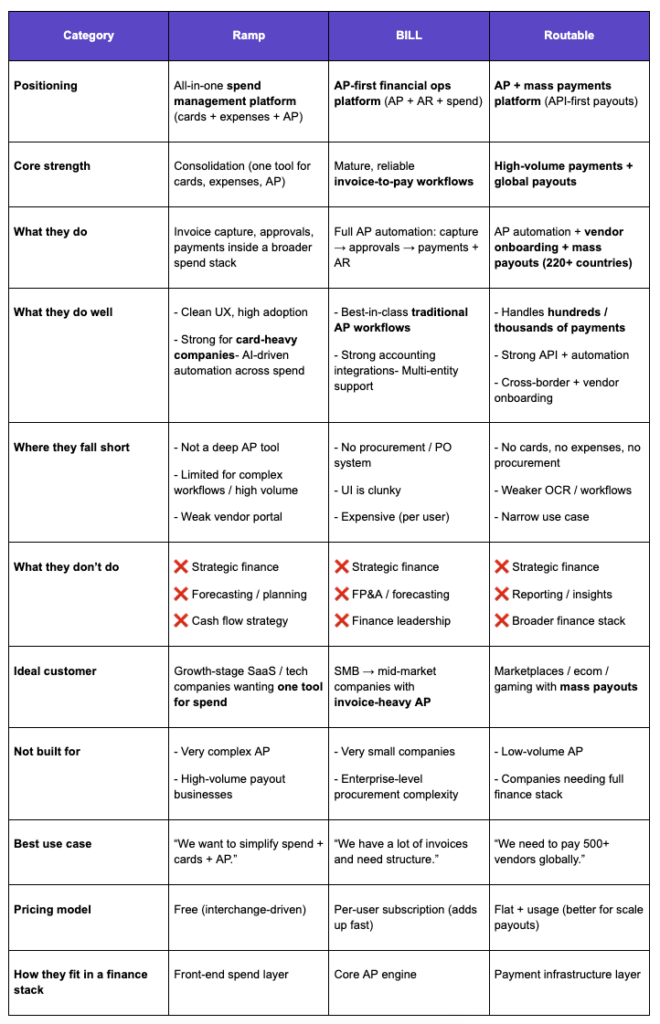
Many companies use accounts payable tools to support this step. Common platforms include Ramp, BILL, and Routable, which help centralize invoice intake, automate approvals, and execute payments.
The goal is not automation for its own sake.
When invoices come through multiple channels, there is no reliable way to know what’s been received, what’s missing, and what’s already been processed.
Centralizing intake eliminates that uncertainty.
3. Automated Coding and Classification
Manual data entry creates inconsistency over time.
As invoice volume increases, manually assigning GL accounts, departments, and cost centers leads to reporting errors and rework during close.
A scalable process uses vendor history and predefined rules to automate coding. This ensures that expenses are classified consistently, which improves reporting accuracy and reduces adjustments.
4. Matching (When Applicable)
Matching ensures that invoices align with what was agreed and delivered.
It depends on the business model:
- Two-way matching compares invoice to purchase order.
- Three-way matching includes goods received.
For SaaS companies, this step is often limited because there’s no purchase order or goods received to match against. For e-commerce and CPG businesses, it becomes critical to prevent overbilling and quantity discrepancies.
5. Approval Workflows with Defined Thresholds
Approvals should follow a structured process, not ad hoc decisions.
This typically includes:
- Automatic approval for smaller invoices
- Routing higher-value invoices to department heads or leadership
This structure supports speed, accountability, and traceability, but without it, approvals become bottlenecks and risk points.
6. Payment Scheduling and Cash Flow Timing
Payment timing is where AP directly impacts liquidity.
In many companies, invoices are paid as soon as they are received. This reduces available cash without providing any benefit. A structured process schedules payments based on vendor terms and cash flow timing, instead of reacting to invoices as they come in.
Paying on the last day of net terms preserves cash while still maintaining strong vendor relationships.
This is why AP is not just an operational function; it’s a working capital lever.
The relationship between payment timing and liquidity is part of a broader system, which we explain in our article: The Cash Conversion Cycle for E-Commerce and Project-Based Businesses: Liquidity Beyond Working Capital.
7. Payment Method Optimization
The way payments are executed also matters. Different payment methods serve different purposes, and choosing the right one depends on whether you’re optimizing for operational control or cash flow.
For day-to-day efficiency and fraud reduction, ACH and virtual cards are preferred over checks. They are easier to track, faster to process, and simpler to reconcile. Checks introduce delays, manual work, and additional fraud exposure, and should only be used when a vendor has no other option.
For cash flow management, credit cards are a good strategic option. Paying vendors by credit card extends your payables window by 30 to 45 days, which preserves cash within the business longer when balances are paid in full. The important caveat is discipline: credit cards used as a float tool are very different from credit cards used as a loan. If balances carry over and interest accumulates, the benefit reverses quickly.
The practical hierarchy is: checks only when necessary, ACH and virtual cards as the operational standard, and credit cards where strategic cash flow extension is the goal and balances are cleared each cycle.
8. Internal Controls
One of the most important controls in AP is the separation of responsibilities.
Without this separation, a single individual can create vendors, approve invoices, and issue payments, creating a clear risk of fraud.
9. Reconciliation and Ongoing Review
A structured AP process improves accounting outcomes.
When invoices are captured and processed correctly, the general ledger reflects accurate expenses, fewer adjustments are needed during close, and financial reporting becomes more reliable.
Regular reviews should include:
- Vendor statement reconciliations
- Periodic review of vendor lists
- Validation of GL coding and accruals
This ensures that the system remains accurate as the business grows.
What This Changes for the Business
When AP is unstructured, the finance team spends time correcting errors, chasing missing invoices, fixing misclassifications, and responding to vendor issues.
When AP is structured, the focus shifts. Liabilities are visible in real time, payments are timed intentionally, and reporting reflects actual performance.
This is typically the point where companies move beyond basic accounting support and start working with a partner like Cypher, where the focus is not just recording transactions but building a finance function that supports decision-making, cash flow control, and scalable operations.
This allows leadership to make decisions based on accurate, timely financial information.
As our client Ben Nowlan, CEO of Sherpa, describes the difference between basic accounting and a structured finance function:
“I've worked with many accounting firms over the last 20 years. There is a difference between an accounting firm and an outsourced finance function that supports businesses in their growth and helps them become financially literate.”
Who This Matters For
This level of structure becomes necessary when:
- Vendor count increases
- Invoice volume grows
- Cash flow timing becomes critical
- Reporting needs to support decision-making
At this point, manual processes create more risk than value.
Conclusion
The default is to treat accounts payable as a back-office function.
In practice, it affects:
- Cash flow timing
- Reporting accuracy
- Vendor relationships
A structured AP workflow replaces reactive processes with controlled systems.
Once that system is in place, finance becomes easier to operate, scale, and trust.
Get Your Pre-Approved Vendor List
If your AP process is a problem, it usually means the finance function has outgrown manual workflows and needs a more structured, scalable system.
At Cypher, we help growth-stage companies build and operate that system, from vendor control and invoice workflows through to reporting, forecasting, and CFO-level decision support.
If you would like our Pre-Approved Vendor List, you can request it through our website.
FAQ
Is an AP tool enough to build a structured AP process?
- No, a tool supports the process, but doesn’t replace it. Without defined workflows and controls, the same issues will persist.
How does AP impact cash flow directly?
- Through payment timing. Paying invoices early reduces available cash, while aligning payments with vendor terms preserves liquidity.
What is the first step to improving AP?
- Understanding and documenting all vendors. Without that, invoice processing remains reactive.
Do SaaS companies need full AP workflows?
- Not always at early stages, but once invoice volume and vendor complexity increase, lack of structure affects cash visibility and reporting accuracy.

Follow our Founder & CEO Salma Hatim on LinkedIn for daily insights and catch her on the Founder Files podcast, available on YouTube and Spotify.
Linkedin Youtube Spotify